
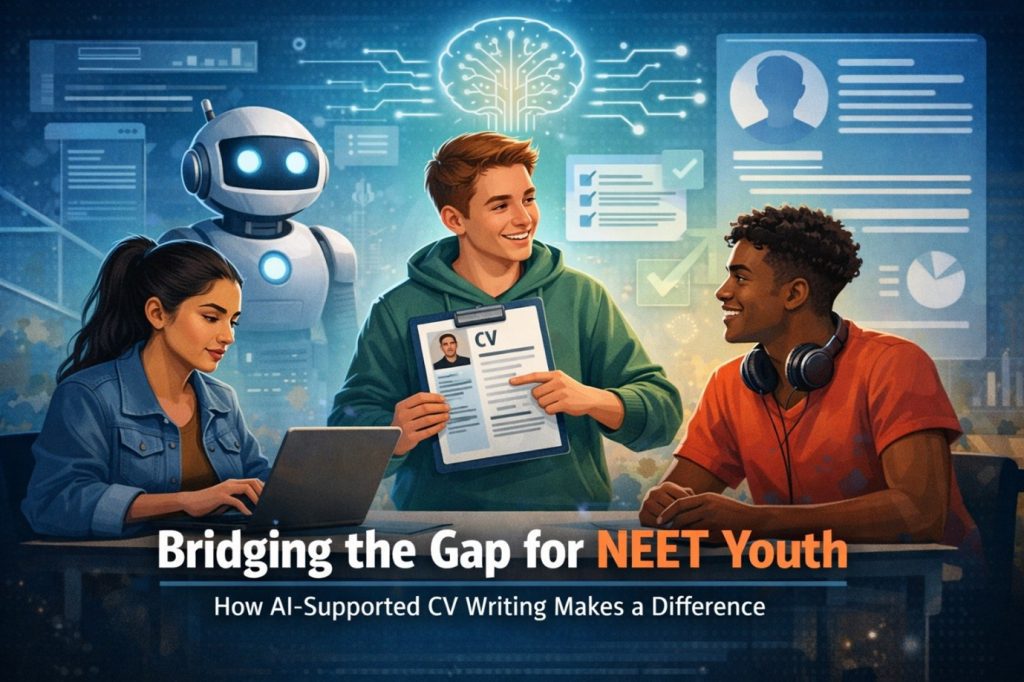
Young people who are Not in Employment, Education or Training (NEET) are often spoken about as a statistic, a policy challenge or a funding priority. But behind that label are individuals with very different experiences, barriers and ambitions.
There are individuals who have left education without a clear direction, some are managing poor mental health, low confidence or difficult home circumstances, others have had negative experiences of school, work or systems that were meant to support them. In some cases, individuals simply do not know where to begin.
For many young people who are NEET, the challenge is not just accessing opportunities. It is knowing how to present themselves in a way that feels credible, confident and realistic. And that is where one of the biggest missing links in engagement often sits: the CV.
The challenge for young people who are NEET
Being NEET is rarely about a lack of potential, more often, it reflects a combination of barriers that make progression feel difficult or out of reach.
These barriers can include low confidence, limited work experience, disrupted education, poor mental health, caring responsibilities, housing instability, lack of digital access or skills and uncertainty about what jobs feel realistic.
For many young people, employability support begins at a point where confidence is already fragile. They may not believe they have enough experience to offer or know what employers are looking for. They may not even feel they have the right to apply. That means engagement is not just about getting a young person through the door. It is about helping them move from uncertainty to action.
How employability support helps and where it can fall short
Good employability support can be transformational for young people who are NEET. The best services do far more than point people towards vacancies. They build confidence, create structure, help identify strengths, support decision-making and provide encouragement at the moments it matters most. For young people with limited experience or disrupted journeys, that human support is often the foundation of progress.
The YouthFuturesFoundation, the UK’s What Works Centre for youth employment, has consistently highlighted the importance of better connected support for marginalised young people as they move towards work. That matters here, because effective support is about helping young people build the confidence, clarity and practical tools to take the next step.
But even strong services can struggle with a familiar problem: time.
Advisors are often working with high caseloads and complex needs. They may be expected to provide coaching, job search support, application help, employer engagement and admin, all within limited appointments. In that context, CV support can become both essential and time-consuming.
And this is where support can sometimes fall short. Not because advisors are not skilled, but because the process of turning a young person’s experience into a strong CV can take far more time and rewriting than it should.
Young people often do not know where to start with a CV
For someone at the start of their working life, the idea of writing a CV can feel overwhelming.
Young people may ask: What do I put on it if I have never had a job? Does school count? Should I include volunteering? How do I explain gaps? What skills do I actually have? Why would an employer choose me? These are not small questions. They are often the difference between someone starting an application and giving up before they even start.
Young people who are NEET often need help identifying the value in what they have done, even if it does not look like traditional work history. School projects, caring responsibilities, sport, creative interests, volunteering, informal responsibilities and personal strengths can all matter, but only if someone helps them see how those experiences translate into something meaningful for an employer.
That is why a CV is not just a document. It is often the first point at which a young person is asked to tell their professional story.
The missing link: AI-supported CV writing
This is where AI-supported CV writing can play a valuable role.
Not generic AI that produces polished but impersonal content and not automation that replaces human judgement, but carefully designed, human-led AI that helps advisors and young people build better CVs faster and more consistently.
Used properly, AI-supported CV writing can: help structure information clearly, turn scattered experience into stronger first drafts, suggest ways to frame strengths and transferable skills, reduce repetitive rewriting and formatting, support tailoring for different roles and make the process less intimidating for young people
Most importantly, it can help young people get started.
A blank page is often a difficult barrier to overcome. AI-supported tools such as Candid can reduce that barrier by giving shape, prompts and language to something that may otherwise feel impossible to begin.
For advisors, this means less time spent on formatting and redrafting. For young people, it means faster progress towards a CV that feels real, usable and reflective of who they are.
Why this matters for providers and employers
For providers, this is about more than efficiency.
If CV support is inconsistent, time-heavy or overly dependent on individual advisor capacity, then engagement suffers. Some young people may receive excellent support, while others wait longer, receive less tailored outputs or leave without something they can actually use.
AI-supported CV writing can help create more consistency across teams while freeing up advisor time for the parts of the role that matter most: coaching, encouragement, relationship-building and progression support.
For employers, better CV support means better applications.
Young people who are NEET are often overlooked not because they lack potential, but because their potential is not being presented clearly enough. If employers receive applications that better reflect strengths, motivation and transferable skills, they are more likely to see the person behind the limited experience.
That matters not only for recruitment, but for widening access and improving early-career pathways.
The future of NEET support needs both AI and human guidance
AI on its own is not the answer.
Young people who are NEET do not need to be pushed towards generic technology and left to figure things out alone. They need confidence, trust, encouragement and guidance. They need professionals who can understand context, handle sensitive issues with care and know when a conversation matters more than a document.
But human support on its own is often in short supply. That is why the future of effective NEET support is not AI or human support. It is both.
The right model is one where: AI reduces friction, advisors keep control, young people feel supported, not processed, outputs are stronger, faster and more consistent and more time goes into progress, not paperwork.
If we want to engage young people who are NEET more effectively, we need to think seriously about the practical points where momentum is often lost.
The CV is one of those points.
And if we get that part right, we do not just improve applications. We help young people move one step closer to seeing themselves as ready, capable and worth the considering.